
The card surcharge ban started 1 October. What it costs you, and what you can still do
FairPayments · · Last updated:
Written by the FairPayments team. Questions? Call 1800 930 164.
From 1 October 2026 you can't add a surcharge because someone paid by card. That covers eftpos, Visa and Mastercard, and American Express, UnionPay and PayPal have also dropped surcharging. You can still raise prices, as long as you don't mislead customers about why, and you can still charge weekend or public holiday surcharges that apply however people pay. The surcharge you used to collect now comes out of your margin, so your card rate matters more than it did.
Most of what's been written about the surcharge ban tells you to take the sign off the counter, and that's fair enough as far as it goes. The harder part is the money that used to come back to you at the till and now doesn't. This guide covers what the ban costs you in dollars, how to put prices up without getting yourself in trouble, and which workarounds are fine.
What changed on 1 October 2026?
From 1 October 2026 you can't add a surcharge because someone paid by card. That covers eftpos, Visa and Mastercard on credit, debit and prepaid cards, including cards from overseas. American Express, UnionPay and PayPal have also dropped surcharging, and PayPal's rule kicked in on 5 October.
Technically the RBA didn't ban you directly. It stopped blocking the card networks from banning surcharges, and they all did. So the rule lives in your merchant agreement, and your payment provider enforces it, not the ACCC. Most providers switched the surcharge setting off on their terminals around 1 October. If your surcharge was set up in your POS instead, check it yourself, because your provider won't have touched it.
How much will the surcharge ban cost my business?
Nobody else seems to put this in dollars, so here are three made-up but realistic businesses. Swap in your own numbers.
The rates are there for comparison. 0.95% is the rate FairPayments offers eligible industries, covered at the end.
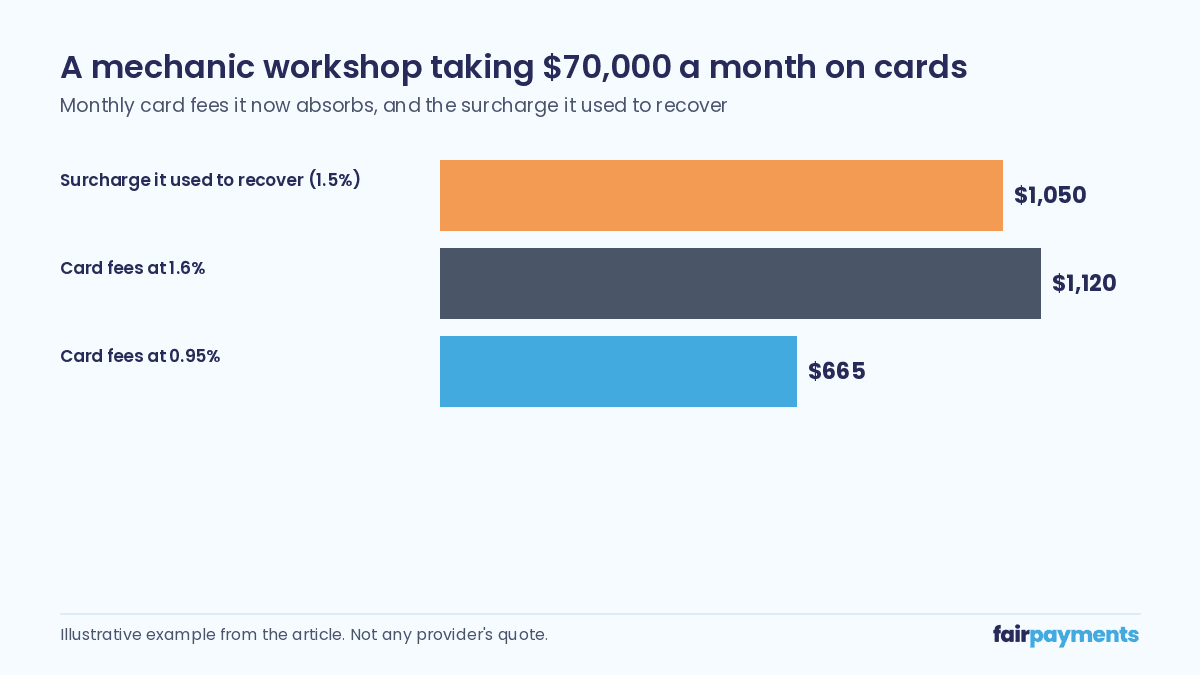
A mechanic workshop takes $70,000 a month on cards and used to surcharge 1.5%, which brought back $1,050 a month. That money stopped on 1 October, and whatever the workshop pays in card fees now comes straight off the bottom line. At a 0.95% rate that would be $665 a month. At 1.6% it's $1,120. The gap between those two is $455 a month, or $5,460 a year.
A butcher takes $60,000 a month on cards, with an average sale of around $45. At 0.95% the card fees are $570 a month. On 1.4% they'd be $840, so the same customers buying the same meat cost the butcher $270 a month more.
A panel beater takes $50,000 a month, mostly in big tickets of $400 to $600. At 0.95% that's $475 a month in fees. Because the sales are large, every bit of percentage rate shows up as real dollars, so the rate matters more here than almost anywhere.
Your figures will be different. What's the same for everyone is that your customers used to pay this, so you probably never looked closely. Now it's your money.
| Business | Monthly card takings | Fees at 0.95% | Fees at a higher rate | Difference per month |
|---|---|---|---|---|
| Mechanic workshop | $70,000 | $665 | $1,120 (at 1.6%) | $455 |
| Butcher | $60,000 | $570 | $840 (at 1.4%) | $270 |
How do I work out my own number?
Grab last month's statement. Put in your card takings and the total fees you paid, and you'll see your effective rate next to FairPayments' published rates. No email needed, and the numbers stay in your browser.
Effective rate
—
Put in last month's takings and fees.
0.95% is for auto, wholesale food and trade supplies businesses. Others, call 1800 930 164 or send your details.
Can I put my prices up to cover card fees?
You're allowed to raise prices to cover card costs, and the ACCC says so plainly. You just can't mislead people about why.
The ACCC's own example is a salon that charges $60 for a haircut with a 1% card surcharge. Folding the surcharge in makes it $60.60. The salon's power and wages have gone up too, so it moves to $65. That's allowed. Telling customers the $5 rise is because of the surcharge ban isn't, because most of it has nothing to do with card fees.
We'd work out your real card cost first and reprice second. ABC reported that about 17% of cafes put up the price of a flat white after 1 October, typically by 50 cents, or almost 10% of the price. That's far more than the 0.5% to 1.5% surcharges most of them were charging. If your real card cost is under 1% and you blame a 10% rise on card fees, customers will work it out, and the ACCC may take an interest too.
Are there any legal ways around the surcharge ban?
A lot of owners are searching for ways around the ban. Most of them don't exist, but a few legitimate options do.
Renaming the surcharge doesn't work. A service fee or admin fee that only applies when someone pays by card is still a card surcharge, and the ACCC says relabelling it may be misleading conduct.
Weekend and public holiday surcharges are still allowed, because they apply no matter how people pay. If you add one, the Australian Consumer Law still wants the minimum total price shown as a single figure where you can work it out.
A cash or PayID discount is allowed. The price you display has to be the full price, though, and you can't make the discounted price more prominent. Tell people about the discount before they order or pay.
A minimum card spend may be possible, but check with your payment provider first. Either way, you can't add a fee to card payments below it.
You can generally go cash only, though some businesses are required to accept cash under ACCC cash acceptance codes. Before you do it, think hard about how many sales would walk out the door. The RBA suggests discounts as a gentler way to steer people.
Invoices follow the payment date. If the invoice went out in September but the customer pays by card on or after 1 October, you may not be able to surcharge it.
Taxi surcharges sit with state and territory regulators, so they follow their own rules. Not-for-profits and business-to-business payments aren't exempt unless a card network's rules or a law says so.
| Option | Allowed? | Condition |
|---|---|---|
| Renaming it a service or admin fee | No | A fee only on card payments is still a card surcharge, and the ACCC says relabelling may be misleading |
| Weekend or public holiday surcharge | Yes | Must apply however people pay, with the minimum total price shown where you can work it out |
| Cash or PayID discount | Yes | Display the full price, don't make the discounted price more prominent, and tell people before they order or pay |
| Minimum card spend | Check first | Ask your payment provider, and never add a fee below it |
| Going cash only | Generally | Some businesses must accept cash under ACCC cash acceptance codes |
Did the interchange fee cuts reach my business?
Also from 1 October, the RBA cut interchange caps. Interchange is the wholesale fee your provider pays the customer's bank. For cards issued in Australia, debit and prepaid is now capped at 8 cents or 0.16%, and consumer credit at 0.30%. Your provider pays interchange, and it decides how much of any cut reaches your price. COSBOA has made the same point many owners are making: lower fees only matter if small businesses actually see them.
Checking takes about ten minutes. Grab your September and October statements. For each month, add up every fee, including terminal rental and any monthly charges, and divide by your card sales. That's your effective rate. If October isn't lower, ring your provider and ask why. From 30 January 2027 large acquirers have to publish how the cuts flowed through, but you don't need to wait for that.
Where does FairPayments fit?
For businesses in the auto industry (mechanics, panel beaters, car dealers and auto parts), wholesale food (butchers and grocers) and trade supplies, FairPayments (Nuvei Preferred Partner) is 0.95% on Visa and Mastercard, a flat 25c per eftpos transaction, and Amex optional at 1.65%. The terminal is $25 a month, free over $1 million a year on cards, and you earn 1 Velocity Point per $25 in card sales, paid to your business. Other businesses can call 1800 930 164. Our full published rates are on one page. Already on a low rate? Ask us about cost-plus pricing.
Related reading
Common questions
When did the card surcharge ban start?
1 October 2026. From that date eftpos, Visa and Mastercard have no-surcharge rules on credit, debit and prepaid cards, and American Express, UnionPay and PayPal have also removed surcharging. PayPal's rule started on 5 October 2026.
Can I still charge a surcharge for paying by card?
Not on eftpos, Visa or Mastercard payments, and American Express has dropped surcharging too. You can still charge fees that apply however someone pays, such as weekend or public holiday surcharges in hospitality.
Are there any loopholes in the surcharge ban?
Not ones that get around it. Renaming a card surcharge as a service or admin fee may be misleading conduct, according to the ACCC. You can still offer discounts for cash or PayID with the full price displayed, choose which payment methods you accept, and charge weekend or public holiday surcharges that apply to everyone.
How will the surcharge ban affect prices?
Businesses can fold card costs into their prices. The ACCC's example is a $60 haircut with a 1% surcharge becoming $60.60. ABC reported about 17% of cafes raised the price of a flat white after 1 October, typically by 50 cents. Businesses can't mislead customers about why prices went up.
Can I offer a discount for cash instead?
Yes. The ACCC says you can offer a discount for a payment method like cash or PayID, as long as you disclose it before people order or pay, display the full price, and don't make the discounted price more prominent.
Can I set a minimum spend for card payments?
A minimum card spend may be possible, but check with your payment provider first. You can't add a fee to card payments below it.
Is the surcharge ban enforced by the ACCC?
Not directly. The RBA stopped blocking the card networks from banning surcharges, and the networks did. The rule sits in your merchant agreement and your payment provider enforces it. The ACCC still enforces the Australian Consumer Law, so misleading customers about price rises or renaming a card surcharge can get its attention.
Can I still surcharge on weekends and public holidays?
Yes, as long as the surcharge applies however people pay. The Australian Consumer Law still wants the minimum total price shown as a single figure where you can work it out.
Can I surcharge an invoice I sent before 1 October?
It follows the payment date. If the customer pays by card on or after 1 October 2026, you may not be able to add a surcharge, even if the invoice went out in September.
Are not-for-profits or business-to-business payments exempt?
No, not unless a card network's rules or a law says so.
What does FairPayments charge?
For businesses in the auto industry (mechanics, panel beaters, car dealers and auto parts), wholesale food (butchers and grocers) and trade supplies, FairPayments (Nuvei Preferred Partner) is 0.95% on Visa and Mastercard, a flat 25c per eftpos transaction, and Amex optional at 1.65%. Other businesses can call 1800 930 164.