
Did your provider pass on the 1 October cut? How to check your real number
FairPayments · · Last updated:
Written by the FairPayments team. Rates checked 15 to 17 November 2026. Questions? Call 1800 930 164.
Maybe. On 1 October 2026 Visa and Mastercard moved every consumer credit card to one interchange rate of 0.30%. Rewards and high-spend credit cards cost much less, while standard credit cards and business cards got dearer, and debit barely moved. So whether you should be paying less depends on which cards your customers use. For some businesses it's close to $0.
Interchange is the fee your provider pays the customer's bank on every card sale, and it's the biggest part of what you pay. The RBA cut the caps on 1 October, the same day surcharging ended. A lot of owners are now waiting for a fee drop that, for their card mix, was never big. Below is what moved, who should be paying less, and a 15-minute way to check your own statement.

What changed on 1 October?
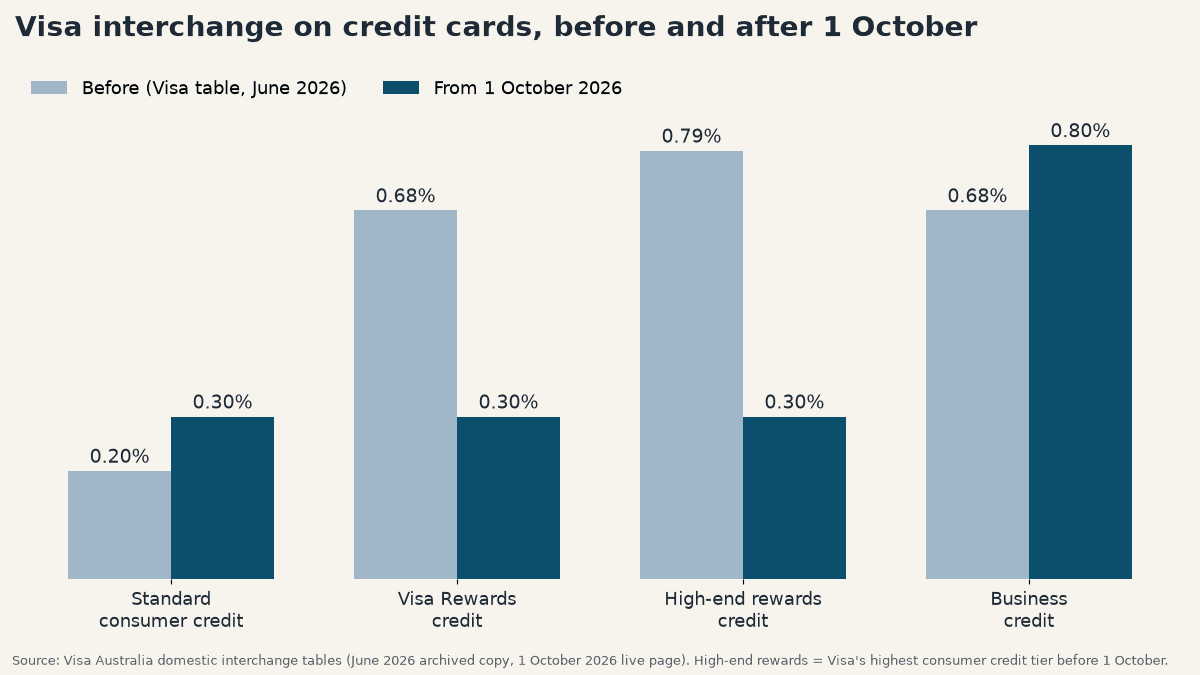
Every consumer credit card on Visa and Mastercard now carries the same interchange: 0.30%. Before that, each scheme had a ladder of rates, with standard cards around 0.20% and rewards cards up near 0.70% or more. The RBA's cap on consumer credit went from 0.8% (with a 0.5% average) to 0.3%.
Business credit cards went the other way, up to 0.80% on both schemes. Debit was already low and the cap dropped from 10c or 0.2% to 8c or 0.16%, so most debit sales moved by a cent or two, if at all.
| Card type | Visa before | Visa from 1 Oct | Mastercard before | Mastercard from 1 Oct |
|---|---|---|---|---|
| Standard consumer credit | 0.20% | 0.30% | 0.19% | 0.30% |
| Rewards and high-spend consumer credit | 0.67% to 0.79% | 0.30% | 0.52% to 0.76% | 0.30% |
| Business credit cards | 0.68% | 0.80% | 0.58% | 0.80% |
| Debit, in store, standard | 4c | 4c | not checked | 4c |
| Debit, contactless over $50 | 0.20% | 0.16% | not checked | 0.16% |
Who should be paying less?
Businesses where a big share of sales are on rewards and high-spend credit cards. Each of those sales now costs your provider roughly half what it did.
Made-up example: $200,000 a month on Visa consumer credit, 40% standard cards and 60% rewards cards. Interchange goes up $80 on the standard cards and down $456 on the rewards cards. That's $376 a month less, about $4,500 a year, that your provider could pass on.
Who might not see a cut at all?
Businesses where most customers pay by debit or standard credit, or with business cards. Same made-up $200,000, but 80% standard cards and 20% rewards cards: interchange goes up $160 and down $152. That's $8 a month more, so there was nothing to pass on.
Your provider isn't short-changing you there. The RBA change cut the expensive cards and lifted the lower-priced ones.
How do I check if my fees went down?
Start with the rate check, or work it out yourself from your September and October figures. For each month, add up every card fee (including terminal rental and monthly fees) and divide by your total card sales. That's your effective rate, and the two months side by side show what changed.
If your plan charges a separate rate for each card type, the change should already show line by line. The RBA notes that large merchants on those plans get the cuts automatically. If you pay one flat rate for everything, it only changes if your provider changes it, so ask them in writing.
If October was a quiet or odd month, compare November too. A big shift in how customers paid can move the number on its own.
The number that matters more: your all-in rate
Surcharging ended on the same day, so every dollar of card fees now comes off your margin. A 0.10% cut on a 1.6% rate still leaves you paying 1.5%. Pass-through tells you how much of the change you got. Your effective rate tells you whether the deal was any good in the first place.
Our surcharge ban guide has the dates and a calculator for what your rate costs you now.
What happens on 30 January 2027?
Large acquirers (those processing more than $10 billion a year in eftpos, Mastercard and Visa sales directly for merchants) must publish their interchange pass-through for October to December 2026 by 30 January 2027, then each quarter for the first year (30 Apr, 30 Jul and 30 Oct 2027). The RBA's formula is the change in their average merchant fees divided by the change in their average interchange, as a percentage, measured against July to September 2026. You don't need to wait for that report to check your own statement.
They've also published average merchant fees by business size and card type since 30 October 2026, which gives you a benchmark for your own rate. Smaller providers don't have to publish either.
Can FairPayments help?
FairPayments is a payments broker on the Gold Coast and in Melbourne. FairPayments powered by Nuvei is cost + 0.5% on Visa and Mastercard (cost + 0.55% with Velocity Points). On our plan, cost is interchange and scheme fees, and our fee covers the processor's fee. Eftpos cards are priced on the same cost-plus basis. Your business earns 1 Velocity Point for every $25 of net Visa and Mastercard sales.
Run the rate check and we'll show you your effective rate, what 1 October changed for your card mix, and whether we're a better value option. Or call 1800 930 164.
Related guides
- Earning points on business payments
- FairPayments powered by Nuvei: Cost + 0.5% (cost + 0.55% with Velocity Points). Our fee covers the processor's fee
- Payment links: get paid by card online
- The card surcharge ban is live: what it costs your business, and what you can legally do
- What is least cost routing, and is it switched on for your business?
- EFTPOS rates compared: what each Australian provider advertises (2026)
Common questions
Did merchant fees go down on 1 October 2026?
Interchange on rewards and high-spend credit cards fell to 0.30%, but standard credit and business cards went up. Whether your fees dropped depends on your card mix and whether your provider passed the change on.
Why haven't my card fees dropped?
Either your customers mostly use debit, standard credit or business cards, where interchange barely fell or went up, or you're on one flat rate that your provider hasn't changed. Ask them in writing.
What is interchange pass-through?
How much of a cut in interchange a provider passes on to merchants. The RBA measures it as the change in average merchant fees divided by the change in average interchange.
When do banks publish their pass-through rates?
Large acquirers must publish their first figures, for October to December 2026, by 30 January 2027, then quarterly.
How do I work out my effective rate?
Add every card fee on your statement, including terminal rental and monthly fees, and divide by your total card sales for the month.
How can I reduce payment processing costs for my small business without losing control over bank and eftpos fees?
Work out your effective rate, ask your provider to switch on least cost routing for debit, and get all-in quotes from two or three providers. Check the exit terms before you sign, so you can move if the numbers stop stacking up.
Sources
- Visa: Australian interchange rates, effective 1 October 2026 (checked 17 Nov 2026)
- Visa: interchange rates effective 1 June 2026 (archived 18 Aug 2026)
- Mastercard: Australia domestic interchange rates, credit (read 15 Nov 2026)
- Mastercard: credit interchange effective 17 April 2026 (archived 6 May 2026)
- RBA Conclusions Paper: Interchange fees
- RBA Conclusions Paper: Impact and implementation
- RBA Conclusions Paper: Appendix C, publication of fees and pass-through (checked 17 Nov 2026)
- RBA: FAQs, removal of card surcharges from 1 October 2026