
What is least cost routing, and is it switched on for your business?
FairPayments · · Last updated:
Written by the FairPayments team. Questions? Call 1800 930 164.
Least cost routing (LCR) lets your terminal send a contactless debit card payment through eftpos instead of Visa or Mastercard when eftpos costs you less. The RBA estimated it cut merchants' debit card costs by about 19% on average, around $310 a year for a median-sized merchant. It only saves you money if your plan charges less for eftpos than for Visa and Mastercard debit. On one flat rate, the saving goes to your provider unless they pass it on as a lower rate.
About 90% of Australian debit cards carry two networks: eftpos, and either Visa or Mastercard. When a customer pays contactless with one of these cards, the payment goes through Visa or Mastercard by default, because of rules those networks set. Least cost routing changes that default. The figures in this guide come from the Reserve Bank of Australia (RBA), checked on 27 October 2026.
What does least cost routing actually do?
Least cost routing is a setting on your merchant account. When a customer pays contactless with a dual-network debit card, it sends the payment through whichever network costs you less, and on average that's eftpos. Some providers give it another name, such as merchant choice routing.
It matters because almost every in-person card payment is contactless now. The RBA counted 95% of in-person card payments as contactless back in 2022, and without routing, every one of those debit payments defaults to the international network.
The RBA expects large debit card issuers (those with more than 1% of debit card transactions) to keep issuing dual-network cards, with both networks working in every form of the card they offer. That expectation is what keeps the choice available to you.
How much can least cost routing save?
The RBA studied about 525,000 merchants' 2022/23 card costs. Merchants with LCR switched on paid about 19% less to accept debit cards than similar merchants without it. For the median merchant, with about $110,000 a year in debit card sales, that came to around $310 a year. For the average merchant, with about $675,000 a year in debit sales, it was around $1,150.
Your pricing plan decides most of that. Merchants on blended plans, which typically charge one rate for Visa and Mastercard and a lower rate for eftpos, paid about 32% less with LCR on. Merchants on unblended plans paid about 8% less. For merchants on fixed, single-rate plans, the RBA found no significant effect on average.
Those results mostly cover in-person payments with a physical card, because routing for online and mobile wallet payments was still rolling out. The RBA expects the savings to grow as routing reaches those payments too.
Why does a flat rate get little from routing?
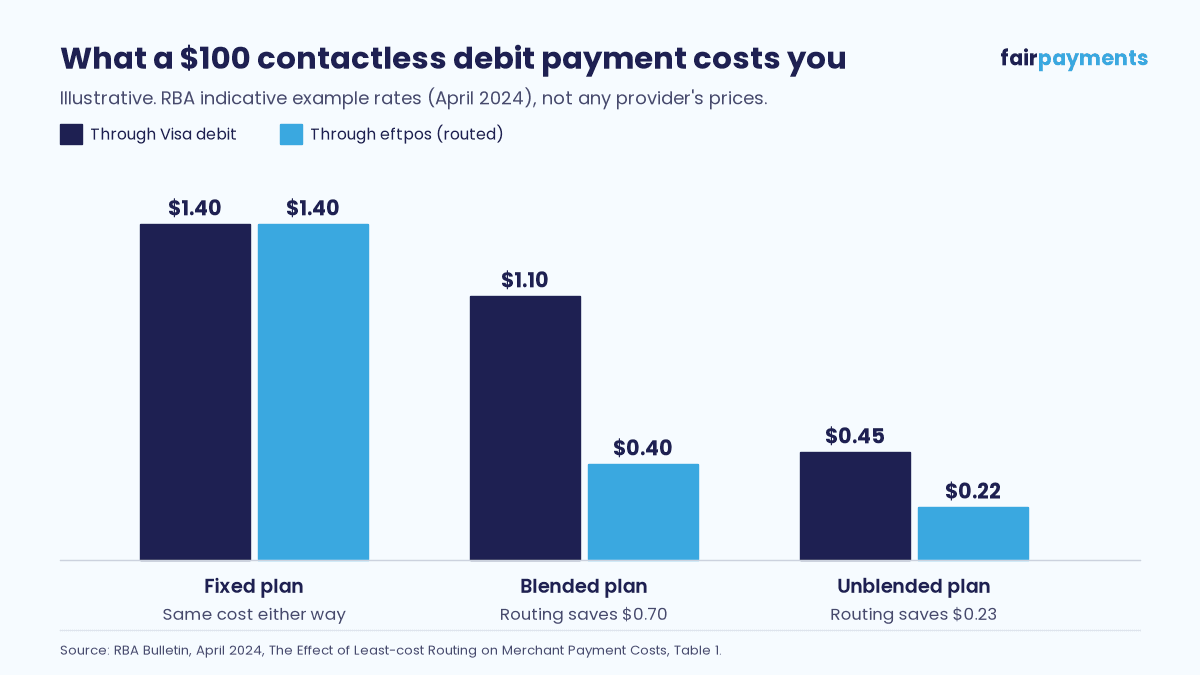
On one flat rate, you pay the same percentage whether a payment goes through eftpos or Visa. Routing still lowers your provider's wholesale cost, but you only see that saving if the provider passes it on as a lower rate. The RBA's own example rates show the gap between plan types.
So the useful question has two parts: is routing switched on, and does your plan price eftpos lower than Visa and Mastercard debit? If you're on one flat rate, the number worth comparing is the flat rate itself.
| Plan type | Through Visa debit | Through eftpos | What routing saves you |
|---|---|---|---|
| Fixed (one rate for every card) | $1.40 | $1.40 | Nothing directly |
| Blended (separate eftpos rate) | $1.10 | $0.40 | $0.70 |
| Unblended plan | $0.45 | $0.22 | $0.23 |
Is it switched on at your bank or provider?
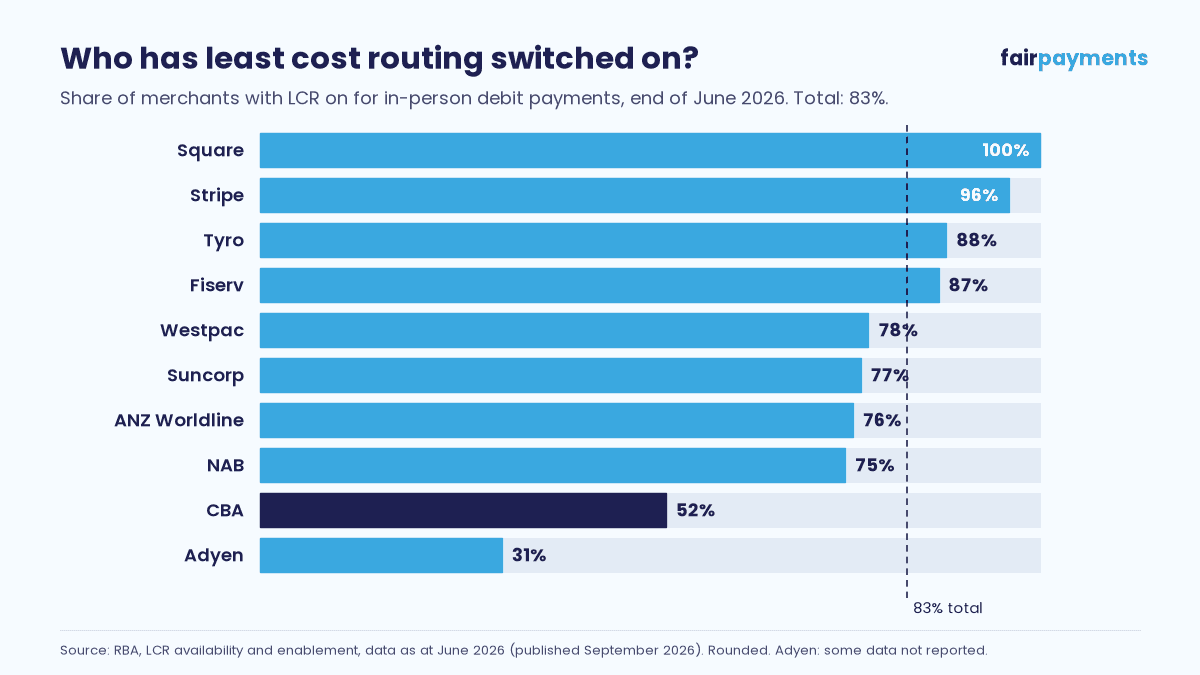
Probably, but not certainly. The RBA's latest figures, published in September 2026, show 83% of merchants at the major acquirers had LCR switched on for in-person payments at the end of June 2026. For another 9%, nobody had made a choice either way, so it was simply off.
Take-up varies a lot between providers. Square reported 100% and Stripe 96%. CBA was lowest among the banks, at 52%, and for 38% of its merchants no choice had been made. The RBA adds its own caution: the providers with the highest switch-on rates don't necessarily give merchants the lowest overall cost.
Online is patchier. Routing for online payments was available to 98% of merchants by June 2026, but the share with it switched on ranged from 1% of merchants at CBA to 100% at Fat Zebra and Braintree.
What's the difference between binary, threshold and dynamic routing?
Most providers use binary routing, which sends every eligible debit payment to one network, usually eftpos. Some use threshold routing, where payments above a set dollar amount go to eftpos and smaller ones go to Visa or Mastercard. The RBA explains why: eftpos is usually priced in cents per payment, while Visa and Mastercard are usually priced as a percentage, so eftpos tends to be cheaper on bigger sales.
Dynamic routing picks the cheapest network for each individual payment. The RBA says very few providers offer it. In its March 2026 conclusions, the RBA noted evidence from one large acquirer that threshold routing delivered almost 90% of the savings of dynamic routing, and it decided not to make any form of routing compulsory for in-person payments.
How do I check if least cost routing is on?
Start with a recent merchant statement. If it splits your debit sales into eftpos and Visa or Mastercard debit, look at the mix. The RBA found merchants with LCR on sent about half their debit payments through eftpos, compared with 14% for merchants without it. If hardly any of yours go through eftpos, routing is probably off.
Then ask your provider, in writing, whether LCR is on for your in-person payments, whether it also covers mobile wallet and online payments, which type of routing they use, and whether your plan charges less for eftpos than for Visa and Mastercard debit.
If the answer to that last question is no, you're on one rate, and routing won't move your bill. Compare the rate itself with other quotes instead. Our guide to lowering your EFTPOS rates shows how to work out the real rate from your statement.
Where does FairPayments fit?
For businesses in the auto industry (mechanics, panel beaters, car dealers and auto parts), wholesale food (butchers and grocers) and trade supplies, FairPayments (Nuvei Preferred Partner) is 0.95% on Visa and Mastercard, a flat 25c per eftpos transaction, and Amex optional at 1.65%. Because eftpos is priced differently, which network a debit payment runs through does change what you pay: on debit sales over about $26.32, eftpos at 25c costs less than 0.95%. The terminal is $25 a month, free over $1 million a year on cards, and you earn 1 Velocity Point per $25 in card sales, paid to your business. Ongoing points need at least $10,000 a month in card sales. Other businesses can call 1800 930 164. See our published rates.
Related reading
- How do I lower my EFTPOS rates? Start with the number on your statement
- The card surcharge ban started 1 October. What it costs you, and what you can still do
- How to find the best EFTPOS provider for your small business
- EFTPOS rates compared: what each Australian provider advertises (2026)
- How much does an EFTPOS machine cost in Australia? (2026 guide)
- Earning points on both sides of your business: payments out and payments in
Common questions
What is least cost routing?
Least cost routing (LCR) is a setting that sends contactless payments on dual-network debit cards through the network that costs the merchant less, usually eftpos instead of Visa or Mastercard. Without it, those payments go through Visa or Mastercard by default.
How much does least cost routing save?
The RBA estimated merchants with LCR on paid about 19% less to accept debit cards than similar merchants without it in 2022/23. That was around $310 a year for a median merchant with about $110,000 in annual debit sales, and around $1,150 for an average merchant with about $675,000.
Does least cost routing work on a flat rate?
Not directly. On one rate for every card, you pay the same whichever network a payment uses. Routing lowers your provider's cost, and you only benefit if they pass that on as a lower rate. The RBA found no significant saving, on average, for merchants on fixed plans.
Does least cost routing apply to credit cards?
No. It applies to dual-network debit cards, which can be processed through eftpos or through Visa or Mastercard. About 90% of debit cards issued in Australia are dual-network, according to the RBA.
Is least cost routing compulsory in Australia?
No. The RBA expects providers to offer and promote it, and large providers report their take-up to the RBA every six months. In March 2026 the RBA decided not to make it a formal requirement for in-person payments. Online and mobile wallet routing are part of a separate RBA consultation.
How do I turn on least cost routing?
Ask your bank or payment provider to switch it on, and get them to confirm in writing which payments it covers (in-person, mobile wallet and online). In June 2026, 9% of merchants at the major acquirers had it off simply because nobody had made a choice.
Does least cost routing change anything for my customers?
The customer pays the same price either way. Routing changes which network processes the payment and what the merchant is charged for it.