
How do I lower my EFTPOS rates? Start with the number on your statement
FairPayments · · Last updated:
Written by the FairPayments team. Questions? Call 1800 930 164.
To lower your EFTPOS rates, work out your effective rate first: add every fee on a month's statement and divide by your card takings. Then push on the parts your provider controls, which are its margin, terminal rental and extra fees. Check least cost routing is switched on and that your pricing lets it save you something. If your provider won't move, get another quote and switch.
Since the surcharge ban, every cent you pay to take cards comes out of your own pocket. Plenty of owners know the rate they were quoted years ago, but not the rate they're actually paying. This guide starts with that number, then works through the fees you can actually move.
How do I work out my real EFTPOS rate?
Pull one full month's merchant statement. Add every fee on it: the transaction fees, terminal rental, any monthly service fee, chargeback fees and anything labelled admin or compliance. Divide that total by your card takings for the month. That's your effective rate.
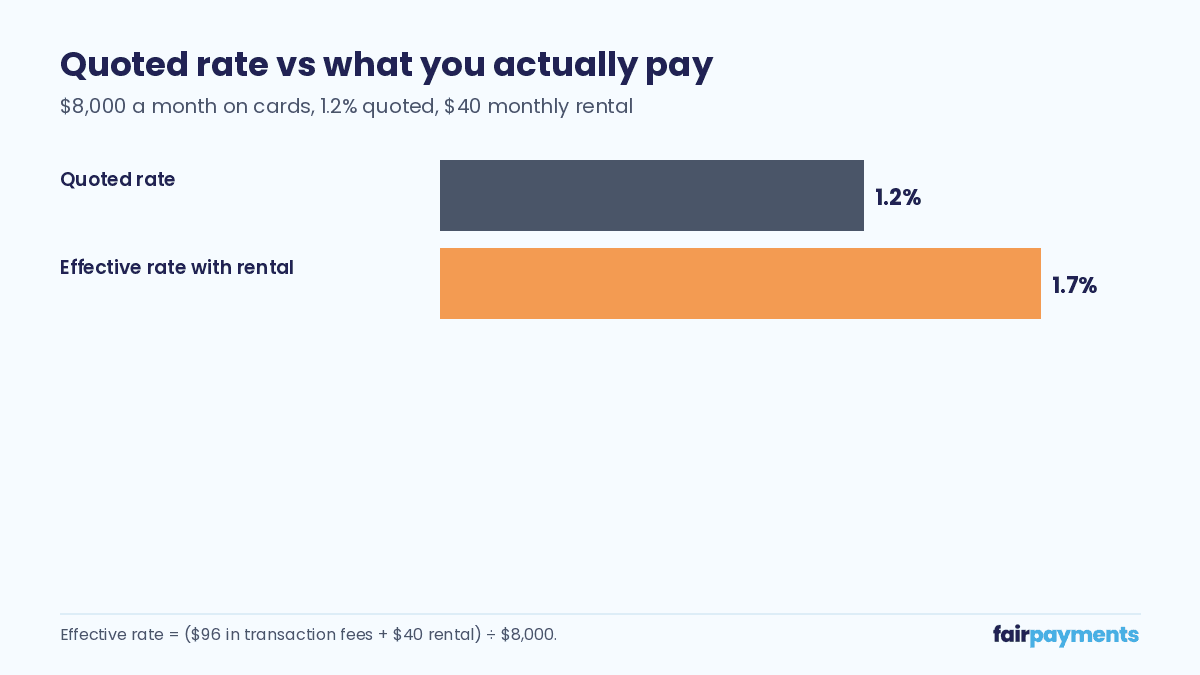
Most people are surprised by it, and usually not in a good way. A business quoted 1.2% that pays $40 a month in rental on $8,000 of takings is really paying 1.7%. Rental hurts more the smaller you are.
If you only do one thing from this article, do this. Every other step depends on knowing that number. From 30 October 2026 the biggest acquirers also publish their average fees each quarter, which gives you a benchmark (how the new rule works).
What's my effective rate?
Put in last month's card takings and every fee you paid, rental included. You'll see your effective rate next to FairPayments' published rates. No email needed, and the numbers stay in your browser.
Effective rate
—
Put in last month's takings and fees.
0.95% is for auto, wholesale food and trade supplies businesses. Others, call 1800 930 164 or send your details.
Which EFTPOS fees can I negotiate?
Your rate is made of three layers. Interchange goes to the customer's bank and is capped by the RBA. Scheme fees go to the card networks. The rest is your provider's margin, plus whatever they charge for the terminal. Your provider controls the margin and the rental, and nothing else, so those are the parts worth pushing on.
Watch for fees that sit outside the headline rate. Monthly minimums, PCI compliance fees, statement fees and rental on a second terminal you stopped using all add up. Ask your provider for the full fee schedule in writing. If they can't give you one, that tells you something.
| Fee | Who gets it | Can you negotiate it? |
|---|---|---|
| Interchange | The customer's bank, capped by the RBA | No |
| Scheme fees | The card networks | No |
| Provider margin | Your payment provider | Yes |
| Terminal rental | Your payment provider | Yes |
| Monthly minimums, compliance and statement fees | Your payment provider | Yes, or ask for them removed |
Does least cost routing lower my fees?
Most Australian debit cards can run on two networks: eftpos, or Visa or Mastercard. When someone pays contactless, the terminal picks. Least-cost routing tells it to pick the cheaper one, which is usually eftpos. Providers give it different names, such as merchant choice routing.
The RBA looked at this in 2024 and found merchants with least cost routing switched on paid nearly 20% less on average to accept debit cards. That's a real saving, and the RBA found small merchants had the most to gain.
Here's the catch. If you're on one flat rate for every card, routing doesn't change what you pay. Westpac says so plainly on its own routing page. Least cost routing only helps when eftpos is priced differently from Visa and Mastercard on your plan. So ask two questions: is it switched on, and does my pricing give it anything to save?
Should I negotiate with my provider or switch?
Negotiating works best when you have volume and a competing quote. Bring three months of statements, your average sale and your mix of debit and credit. Ask for a lower margin, rental waived or reduced, and least cost routing switched on. Some providers will offer a custom rate once you're over a certain monthly volume.
Switching makes more sense when your provider won't move, when you're paying rental on hardware you'd happily replace, or when the gap is big. Before you switch, check for a contract end date and any break fee. A terminal swap is usually a short job, but plan it for a quiet day.
Our view: if your effective rate is more than half a percent above what you can get elsewhere, a phone call is worth ten minutes. If they won't budge, move.
Where does FairPayments fit?
For businesses in the auto industry (mechanics, panel beaters, car dealers and auto parts), wholesale food (butchers and grocers) and trade supplies, FairPayments (Nuvei Preferred Partner) is 0.95% on Visa and Mastercard, a flat 25c per eftpos transaction, and Amex optional at 1.65%. The terminal is $25 a month, free over $1 million a year on cards, and you earn 1 Velocity Point per $25 in card sales, paid to your business. Other businesses can call 1800 930 164. Our full published rates are on one page. Already on a low rate? Ask us about cost-plus pricing.
Related reading
Common questions
How do I lower my EFTPOS fees?
Work out your effective rate from a full month's statement, then push on the parts your provider controls: its margin, terminal rental and extra fees. Check least cost routing is switched on, and compare at least one other quote. If your provider won't move, switching is usually straightforward.
What is a good EFTPOS rate in Australia?
It depends on your volume, average sale and card mix, so compare your effective rate, including rental, rather than the headline rate.
Does least cost routing lower my fees?
It can. The RBA found merchants with least cost routing paid nearly 20% less on average to accept debit cards. It only helps if your plan prices eftpos differently from Visa and Mastercard. On a single flat rate for all cards, routing doesn't change what you pay.
Can I negotiate my merchant fees?
Yes. The provider's margin and terminal rental are the negotiable parts. Interchange and scheme fees aren't. Bring three months of statements and a competing quote.
Is it worth switching EFTPOS providers?
If your effective rate is well above what you can get elsewhere and your provider won't match it, usually yes. Check your contract for an end date or break fee first.
What is an effective rate?
Your total card fees for a month, including terminal rental and any monthly or compliance fees, divided by your card takings for that month. A business quoted 1.2% that pays $40 a month in rental on $8,000 of takings is really paying 1.7%.
What fees should I look for on my merchant statement?
Transaction fees, terminal rental, monthly service fees, monthly minimums, chargeback fees, PCI compliance fees, statement fees, and rental on any terminal you no longer use.
What does FairPayments charge?
For businesses in the auto industry (mechanics, panel beaters, car dealers and auto parts), wholesale food (butchers and grocers) and trade supplies, FairPayments (Nuvei Preferred Partner) is 0.95% on Visa and Mastercard, a flat 25c per eftpos transaction, and Amex optional at 1.65%. Other businesses can call 1800 930 164.