
What is interchange plus plus (IC++) pricing? A plain guide for Aussie businesses
FairPayments ·
Short answer: With interchange plus plus, you pay the real cost of each card payment. Then you pay one fixed service fee on top. You can see both.
It's also called interchange++, IC++ or cost‑plus pricing.
The real cost is the fee to the customer's bank (interchange) and the card network's fee (scheme fees). On our plan, our fee covers the processor's fee for each payment.
On a flat rate, it's all rolled into one number. You can't see what's cost and what's the provider's fee.
The Reserve Bank (RBA) found small merchants on unblended (cost‑plus style) plans paid 0.9% on average. That was before the 1 October 2026 cut.
In our examples, most came in under 1%. Four of our five example businesses landed between 0.74% and 0.79%. Each had an average sale above $50.
The café, with small sales, paid more. Your rate depends on your card mix.
It's the same pricing model large retailers and enterprises get. Since 1 October 2026, you can't add a surcharge on Visa, Mastercard or eftpos cards.
So the card fee comes out of your margin. It pays to know what you're paying for.
What does "interchange plus plus" mean?
The name tells you how the price is built. You pay interchange, plus scheme fees, plus a service fee:
| Part | What it is | Who gets it | Who sets it |
|---|---|---|---|
| Interchange | A fee for each card payment | The customer's bank | The card network, within caps set by the Reserve Bank (RBA) |
| Scheme fees | Fees for using the card network | Visa, Mastercard or eftpos | The card network |
| Processor's per‑transaction fee (on some plans) | A small fixed fee for processing each payment | The payment processor | The processor |
| Service fee | What your provider charges to run the service | Your payment provider | Agreed with you, and fixed |
On our plan, "cost" is the first two, and our service fee covers the processor's fee. On IC++ you pay cost as it is, and the service fee is the one number that doesn't move.
Interchange plus (IC+) vs interchange plus plus (IC++). The terms get used loosely. Usually IC+ means interchange is passed through and everything else (scheme fees and the provider's fee) is bundled into one number.
IC++ shows scheme fees separately too, so you can see each layer. If a quote says "interchange plus", ask what's inside the plus.
The RBA calls these "unblended" plans. A flat or blended plan (the RBA calls the simplest ones "single-rate plans") charges one rate for every card, whatever it costs.
Does IC++ cost less than a flat rate?
Often, yes, but it depends on your card mix. The RBA's March 2026 Conclusions Paper found that, on average, small merchants on single-rate plans paid 1.4% of their card sales, while small merchants on unblended plans paid 0.9%. Only 19% of small merchants were on unblended plans.
These five example businesses show cost + 0.5% next to a 1.4% flat rate.
| Example business | Average sale | Assumed card mix (debit / personal / business) | Flat rate 1.4% (example) | Cost + 0.5% (example) |
|---|---|---|---|---|
| Tyre shop | $300 | 70% / 25% / 5% | 1.4% | 0.74% |
| Auto workshop | $450 | 67% / 25% / 8% | 1.4% | 0.76% |
| Retail shop | $130 | 67% / 30% / 3% | 1.4% | 0.76% |
| Restaurant | $80 | 67% / 30% / 3% | 1.4% | 0.79% |
| Café | $18 | 80% / 18% / 2% | 1.4% | 1.03% |
Visa and Mastercard only. Debit interchange at the RBA's 8-cent benchmark, credit interchange at the RBA caps, scheme fees at the RBA's 2024/25 averages for acquirers on Australian-issued cards across eftpos, Visa and Mastercard (about 0.10% on debit and 0.12% on credit). On our plan, the 0.5% fee covers the processor's fee.
A debit share of about two-thirds is in line with the RBA's merchant data. Amex, eftpos-routed payments and terminal rental aren't included.
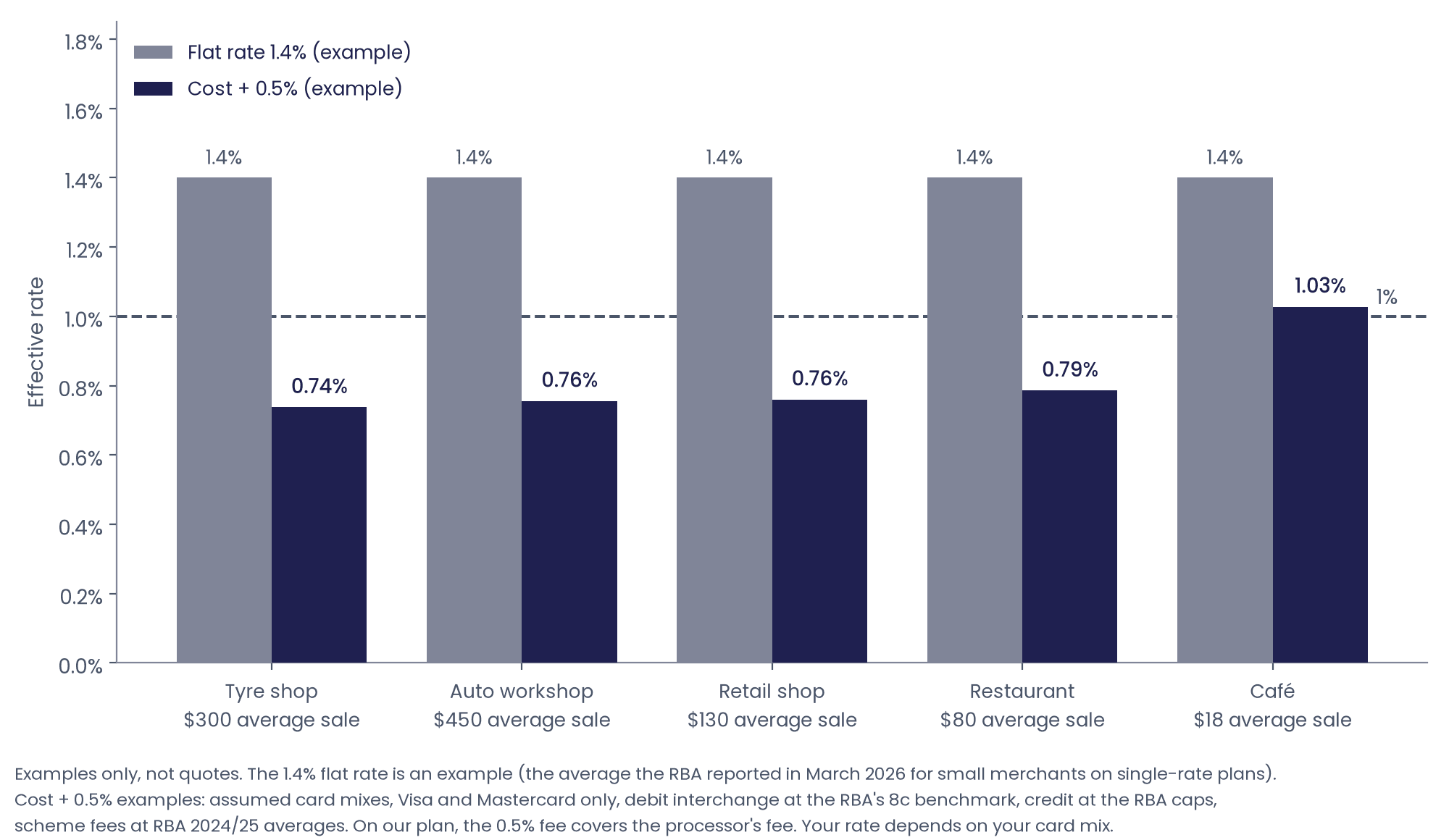
With Velocity Points at cost + 0.55%, add 0.05 points and the tyre shop, auto workshop, retail shop and restaurant still stay under 1%. For those four, if debit is charged as a percentage (capped at 0.16%) rather than a fixed fee, the rate rises by up to about 0.1 points and still stays under 1%.
In dollars: a business turning over $1 million a year on cards pays $14,000 at a 1.4% flat rate (example). At about 0.76%, like the auto workshop above, it's about $7,600. That's roughly $6,400 a year back in the business.
Example: $1 million a year in card sales
What the same year costs on two pricing models
Flat rate 1.4% (example)
One percentage, cost and fee rolled together
$14,000
a year in card fees
Interchange++ cost + 0.5% (example)
About 0.76%, like the auto workshop example
About $7,600
a year in card fees
On our plan, cost is interchange and scheme fees, and our fee covers the processor's fee.
Roughly $6,400 a year back in the business (example)
- You see the real cost of every card.
- Interchange cuts come straight to you.
- One fixed fee, easy to check each month.
- The same pricing model large retailers and enterprises get.
Example only, not a quote. Visa and Mastercard, using the auto workshop card mix from the table above. Your rate depends on your card mix and sale sizes.
Check your rateWhy the café is different. In our examples, part of the cost is fixed per payment (the 8-cent debit interchange). On an $18 coffee and toastie, that fixed fee weighs a lot more than on a $450 brake job.
The café example still beats a 1.4% flat rate, but at 1.03% it would do better on a lower flat rate, like the 0.95% Tyro and Clover option below.
What did the RBA change on 1 October 2026?
The RBA's Payments System Board finished its review of merchant card payment costs in March 2026 (Conclusions Paper, published 31 March and corrected on 19 June 2026). These were the changes for cards issued in Australia and used here, all from 1 October 2026 unless noted:
| What | Before | From 1 October 2026 |
|---|---|---|
| Personal (consumer) credit interchange | Capped at 0.8%, with a 0.5% average benchmark | Capped at 0.3%, benchmark removed |
| Debit and prepaid interchange | Capped at 10 cents per payment (or a percentage cap), 8-cent average benchmark | Capped at 8 cents (or 0.16% if charged as a percentage), 8-cent average benchmark kept |
| Business (commercial) credit interchange | Capped at 0.8%, with a benchmark | Still capped at 0.8%, benchmark removed |
| Scheme fees | Not capped | Still not capped |
| Card surcharges | Allowed, up to the cost of acceptance | Ended on eftpos, Visa and Mastercard cards |
Surcharging. The RBA lifted its ban on "no-surcharge" rules. From 1 October 2026, eftpos, Visa and Mastercard brought in no-surcharge rules.
The ACCC says businesses can no longer surcharge Visa, Mastercard, American Express, UnionPay or eftpos cards. The ban doesn't cover weekend and public holiday surcharges that aren't about how someone pays.
You can still adjust your prices to cover card costs, as long as you don't mislead anyone about prices or why they went up.
Debit barely moved. The cap came down to 8 cents, but the 8-cent average benchmark stayed. The RBA had proposed 6 cents and decided against it.
Still to come, and what's already started:
- Scheme fees. They still aren't capped. The RBA expects Visa, Mastercard and eftpos to publish "Scheme Fee Roadmaps" by 1 April 2027, and says it will consider further action if progress is too slow.
- Foreign cards. From 1 April 2027, interchange on foreign-issued cards used in Australia is capped at 1.0%.
- Statements. From the first full statement period starting on or after 1 April 2027, acquirers (card payment providers) must show more on merchant statements, like the relative cost of domestic and foreign cards, and of in-person and online payments.
Public fee data. The card networks, and acquirers handling over $10 billion a year of card payments in Australia directly for merchants, must now publish fee data each quarter (the first was due by 30 October 2026).
For the first four quarters after the cuts, those acquirers must also report how much of the interchange cuts they passed on, with the first report due by 30 January 2027. The RBA will republish these on its website.
What does this mean on a flat rate vs IC++?
On a flat or blended rate, your rate stays the same unless your provider chooses to lower it. If you take a lot of personal credit cards, the interchange on those payments may have fallen sharply, and on a flat rate that saving can sit with your provider. The new pass-through reports from large acquirers are there to put public pressure on that.
On IC++, interchange is passed through at cost, so if the interchange on your cards falls, your cost falls with it. How much you notice depends on your card mix: a business taking mostly debit may see little change, while one taking lots of personal credit cards will see more.
To see what IC++ could cost your business, pop your monthly card sales into our rate check. For more on the cuts, see our guide to whether card fees dropped on 1 October. For the full rundown on the ban, see the card surcharge ban guide.
Why is interchange++ a great model for merchants?
Because it's honest about where your money goes.
- You see the real cost of every card. Debit, personal credit, business credit, domestic or overseas. Each one is charged what it actually costs, so your statement finally makes sense.
- Cuts come straight to you. When interchange falls, your cost falls with it. Nobody has to decide to pass it on.
- One fixed service fee. It's the only part your provider controls, so it's easy to check month to month. If it ever changed, you'd see it.
- The same pricing model large retailers and enterprises get. The RBA notes that large merchants tend to choose unblended plans. Now a tyre shop or a local restaurant can be on the same model.
- Fair by design. You pay for the cards your customers actually use. A debit-heavy business stops quietly covering the cost of someone else's rewards cards.
The trade-off is that your rate moves a little with your card mix, so you won't see one tidy number every month. In our examples, businesses with average sales above $50 still came out ahead.
Who does IC++ suit?
IC++ is usually the better fit if you have:
- Average sales above about $50. Workshops, tyre shops, trades, retailers, restaurants and wholesale suppliers.
- Lots of debit. Debit interchange is capped low, so debit-heavy businesses do well.
- A wish to see what you pay. One fixed service fee is easy to check from month to month.
A flat rate can still make more sense if you have:
- Lots of small sales. Cafés, bakeries and takeaways, as in the café example above.
- Lots of business credit cards. Their interchange cap is still 0.8%, well above the 0.3% cap on personal cards.
- A strong preference for one simple number. That's a fair choice too.
If a flat rate suits you better, FairPayments also offers Tyro and Clover at 0.95% flat, including eftpos.
How do I check what I'm paying now?
The quickest way is to pop your monthly card sales into our rate check. If you'd like to work it out yourself:
- Add up your total card fees, including terminal rental and any monthly or minimum fees.
- Divide by your total card sales. That's your effective rate. $1,400 in fees on $100,000 of sales is 1.4%.
- Look at how the fees are shown. Interchange and scheme fees listed separately means some form of interchange plus. One percentage on everything means a flat or blended rate.
- Check debit routing. Least-cost routing sends dual-network debit cards over the lower-cost network. Our guide shows how to check least-cost routing is switched on.
If your effective rate is above 1% and your average sale is more than a few coffees, it's worth seeing what IC++ would cost you. There are more ideas in how to lower your EFTPOS rates, and you can compare advertised rates in EFTPOS rates compared.
How do I switch to interchange plus plus?
Here are the steps:
- Check your rate. Pop your current rate and monthly card sales into our rate check.
- Tell us about your business. Your card sales, average sale and the POS you use.
- Get approved. Approval and identity checks apply. Onboarding is typically within 24 hours.
- Start taking payments. We can handle the switch for you. There are 800+ POS integrations via Linkly, and we'll check your POS before the terminal goes out.
There's no setup fee, and you can leave with 30 days' notice.
What does FairPayments charge on IC++?
FairPayments powered by Nuvei gives every business the same pricing model large retailers and enterprises get: the wholesale card cost, plus one fixed fee for running the service (our staff, technology and the processor's fee).
- Cost + 0.5%, or cost + 0.55% with Velocity Points.
- "Cost" means interchange and scheme fees.
- Eftpos cards are priced on the same cost‑plus basis.
- PAX A910s terminal at $25 a month, free over $1 million a year in card sales.
- In person and online.
- Nuvei is PCI DSS Level 1.
- Support Monday to Friday, 9am to 6pm AEST, from Gold Coast and Melbourne.
With Velocity Points you earn 1 point per $25 of eligible Visa and Mastercard sales once you process $10,000 a month. Amex and Diners don't earn. More in our business points guide.
Ready to stop paying a blended rate?
The ones with bigger average sales generally came in lower. Put your current rate and card sales into the rate check and see how it compares.
No setup fee, and we can handle the switch for you. If a flat rate suits you better, we'll tell you.
Check your rate or call 1800 930 164, Monday to Friday, 9am to 6pm AEST.
Related guides
- Earning points on business payments
- FairPayments powered by Nuvei: Cost + 0.5% (cost + 0.55% with Velocity Points). Our fee covers the processor's fee
- Payment links: get paid by card online
- Did your provider pass on the 1 October cut? How to check your real number
- The card surcharge ban is live: what it costs your business, and what you can legally do
- What is least cost routing, and is it switched on for your business?
FAQs
What is interchange plus plus (IC++) pricing?
It's card pricing where you pay the real cost of each payment (interchange and scheme fees, and on some plans the processor's per-transaction fee) plus one fixed service fee. On our plan, the service fee covers the processor's fee. It's also called interchange++ or cost-plus pricing.
What's the difference between interchange plus and interchange plus plus?
Usually, interchange plus passes interchange through and bundles scheme fees and the provider's fee into one number. Interchange plus plus shows scheme fees separately as well. Ask any provider exactly what's inside their "plus".
Does IC++ cost less than a flat rate?
Often, but it depends on your card mix. On average, the RBA found small merchants on single-rate plans paid 1.4%, against 0.9% on unblended plans. Small-ticket businesses like cafés can do better on a flat rate.
Will I pay under 1% on IC++?
It isn't guaranteed. In our examples, most came in under 1%. The RBA found small merchants on unblended plans averaged 0.9% even before the October cut. In our worked examples at cost + 0.5%, a tyre shop, auto workshop, retail shop and restaurant came in between 0.74% and 0.79%. A café with an $18 average sale came to 1.03%.
What did the RBA change on 1 October 2026?
The cap on interchange for personal credit cards issued in Australia fell from 0.8% to 0.3%. The debit cap came down from 10 cents to 8 cents (or 0.16%), with the 8-cent average benchmark unchanged. Business credit stayed capped at 0.8%, scheme fees weren't capped, and surcharges ended on eftpos, Visa and Mastercard cards. A 1.0% cap on foreign-issued cards starts on 1 April 2027.
Did the 1 October 2026 changes lower my card fees?
It depends on your pricing and card mix. On IC++, interchange is passed through at cost, so if the interchange on your cards fell, your cost fell with it. On a flat rate, it only reaches you if your provider lowers your rate.
Why is interchange++ a fair model?
You see the real cost of each card, cuts come straight to you, and there's one fixed service fee you can check. It's the same pricing model large retailers and enterprises get.
What does FairPayments charge?
FairPayments powered by Nuvei charges cost + 0.5%, or cost + 0.55% with Velocity Points. Cost covers interchange and scheme fees. Our fee covers the processor's fee. Tyro and Clover are available at 0.95% flat, including eftpos.
How do I switch?
Check your rate, tell us about your business, and get approved. Onboarding is typically within 24 hours, there's no setup fee, and we can handle the switch for you.
Sources
- RBA, *Review of Merchant Card Payment Costs and Surcharging: Conclusions Paper*, March 2026 (small-merchant fees by plan type, p. 76; scheme fees, Table 9, p. 64; debit share of card payments)
- RBA media release 2026-10, 31 March 2026
- RBA Conclusions Paper, Interchange Fees
- RBA Conclusions Paper, Scheme Fees (ch. 4), Transparency of Wholesale Fees (ch. 5), Competition in Card Acquiring (ch. 6) and Implementation (ch. 8, Table 10), same PDF as above
- RBA Standard No. 2 of 2016 (debit and prepaid interchange) from 1 October 2026
- ACCC, *Card surcharges*